
Tick scalping is one of the fastest and most precise trading methods available. It involves making ultra-short-term trades based on very small price movements, or “ticks.” This technique requires focus, speed, and a sound strategy, and it can be used in various markets including Forex and futures.
In this article, we explain tick scalping meaning, how it works in Forex, and what kind of strategy can give traders an edge.
What Is Tick Scalping?
Tick scalping refers to a trading technique where traders attempt to profit from extremely small price movements, often just one or two ticks. A “tick” is the smallest possible change in the price of a financial instrument.
This method is popular among professional day traders who rely on high-frequency trading setups. Trades are opened and closed within seconds or minutes, and the goal is to capture quick gains repeatedly throughout the trading session.
It is most commonly used in highly liquid markets like Forex and futures, where price movement is frequent and spreads are tight.
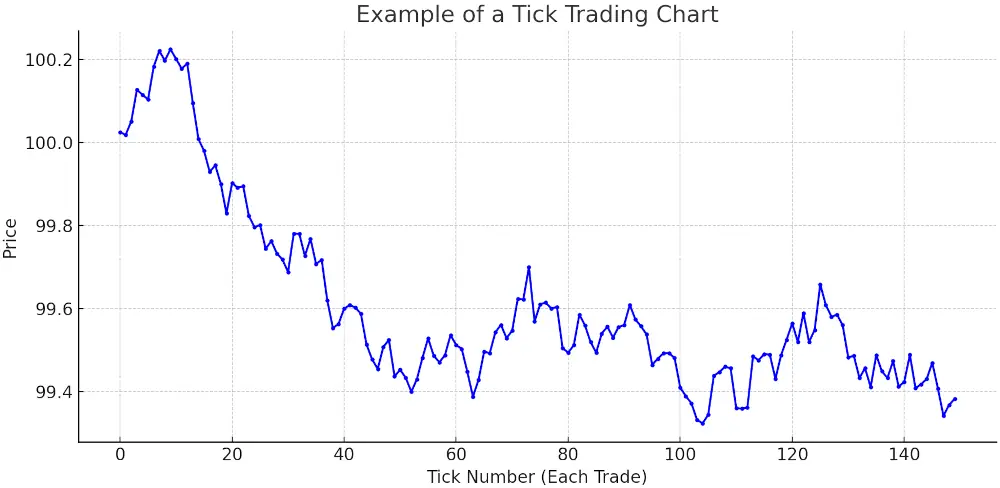
Below is an example of a tick trading chart. Each point on the x-axis represents a single trade (or tick), and the y-axis shows the price at which the trade occurred. This kind of chart is useful for scalpers and high-frequency traders who need to see price movements at the most granular level.
Tick Scalping Meaning and Its Role in Fast-Paced Markets
Understanding tick scalping meaning is crucial for anyone exploring short-term trading. Unlike swing trading or position trading, this type of scalping focuses on tiny fluctuations in price. Scalpers usually trade based on tick charts, which display price changes for every market tick rather than over time intervals like minutes or hours.
This means tick scalpers don’t wait for trend confirmation or long setup periods. Instead, they analyze immediate price actions to enter and exit trades quickly, often hundreds of times in a single session.
How Tick Scalping Forex Trading Works
Tick scalping in Forex involves buying or selling a currency pair and closing the position almost immediately after it moves by a few pips or ticks. Here’s how it generally works:
Key Features
- Extremely short holding time: Often just a few seconds to a couple of minutes
- High volume of trades: Multiple entries and exits throughout the day
- Small profits per trade: Typically 1–3 ticks per trade
- Focus on high liquidity pairs: EUR/USD, GBP/USD, USD/JPY
- Requires low spreads and fast execution
Because the Forex market is open 24 hours and highly liquid, it’s a suitable environment for tick scalping strategies, especially when combined with advanced tools and reliable internet connectivity.
Tick Scalping Strategy Essentials
A good tick scalping strategy balances speed with discipline. Traders must be highly responsive, execute with precision, and avoid emotional decisions.
Core Components of a Tick Scalping Strategy
- Tick Chart Usage: Monitor each price tick instead of traditional time-based charts
- Level II Data or Order Flow Analysis: Observe market depth and real-time order activity
- Low Latency Broker: Ensure ultra-fast execution to capitalize on minimal price changes
- Preset Entry/Exit Rules: Use tight stop-losses and profit targets
- No Lag Indicators: Favor tools like VWAP, EMA, and bid/ask volume rather than slow oscillators
Many tick scalping strategies avoid over-reliance on indicators, focusing instead on raw price action and market behavior.
Tips for Tick Scalping
- Trade Only in High-Liquidity Periods: Focus on times when volume is highest, like the London or New York session.
- Use a Direct Market Access (DMA) Broker: Minimize slippage and execution delays.
- Keep a Trading Journal: Document patterns, entry/exit times, and outcomes.
- Limit Distractions: It requires full concentration, don’t multitask.
- Avoid Overtrading: Stick to a pre-set number of trades to prevent burnout and emotional decisions.
Did You Know?
- Tick scalping is often used by algorithmic trading bots that execute trades in milliseconds.
- Some proprietary trading firms specialize entirely in tick scalping for futures and Forex markets.
- Tick charts can differ across platforms, a tick on one platform may not appear at the same time on another, depending on data feed speed.
- The smallest profits in tick scalping can compound significantly when done consistently and with low fees.
Frequently Asked Questions (FAQ)
What is tick scalping in simple terms?
It is a trading method where a trader enters and exits positions quickly, aiming to profit from very small price changes (ticks).
Is tick scalping legal?
Yes, it is legal in most markets, though some brokers may restrict or discourage it due to the rapid execution and high frequency of trades.
Can beginners try tick scalping?
It’s possible, but not recommended. It demands fast reactions, deep understanding of price action, and discipline, skills usually developed over time.
What timeframes are best?
Tick scalpers don’t use traditional timeframes like 1-minute or 5-minute charts. They typically use tick charts, which display a candle after a set number of trades (e.g., 100 ticks).
What is the difference between tick and regular scalping?
Regular scalping may use time-based charts and slightly longer trades. Tick scalping is more granular and trades based on individual ticks in price.
How do I start scalping in Forex?
To start you need:
- A broker with low spreads and fast execution
- Tick charts and Level II data
- A predefined, tested tick scalping strategy
Conclusion
Tick scalping is a powerful method for traders who want to take advantage of small price movements with rapid trades. It is especially popular in Forex markets due to high liquidity and tight spreads. Whether you’re a professional or an advanced trader, mastering a scalping strategy requires speed, precision, and a sound understanding of market behavior. As with any trading approach, consistent practice and risk management are essential to succeed.
To further refine your scalping strategy, explore our Day Trading category for in-depth insights and proven techniques.