
Understanding the gamma option is essential for anyone serious about advanced options trading. This article dives deep into what gamma represents, how it influences option pricing, and why traders use gamma-focused strategies such as gamma scalping and gamma hedging.
Whether you’re new to options or refining your trading system, learning how to interpret gamma can enhance your risk management and profitability.
What Is a Gamma Option?
In options trading, a gamma option refers to the Greek letter Gamma (Γ), which measures the rate of change of Delta, the first derivative of an option’s price with respect to the underlying asset. In simpler terms, gamma tells you how much the delta will change when the underlying asset’s price changes. It’s a second-order Greek and is especially critical for understanding the behavior of options close to expiry or near-the-money.
For active traders and professionals, gamma is a key metric in managing risk and constructing advanced trading strategies such as gamma scalping and gamma hedging. In this article, we break down what gamma represents, how it behaves, and how it can be used in a broader gamma trading strategy.
Understanding Gamma in Stock Options
To understand gamma in stock options, it’s useful to first recall what delta is. Delta measures how much an option’s price moves in response to a $1 change in the underlying asset. Gamma, in turn, measures how much that delta will change if the underlying moves another dollar.
- High gamma means delta is very sensitive, small movements in the underlying can change your risk profile significantly.
- Low gamma means the delta is stable and changes more gradually.
Key Points
- Gamma is highest for at-the-money options and near expiry.
- Deep in-the-money or out-of-the-money options have low gamma.
- Gamma is always positive for long options and negative for short options.
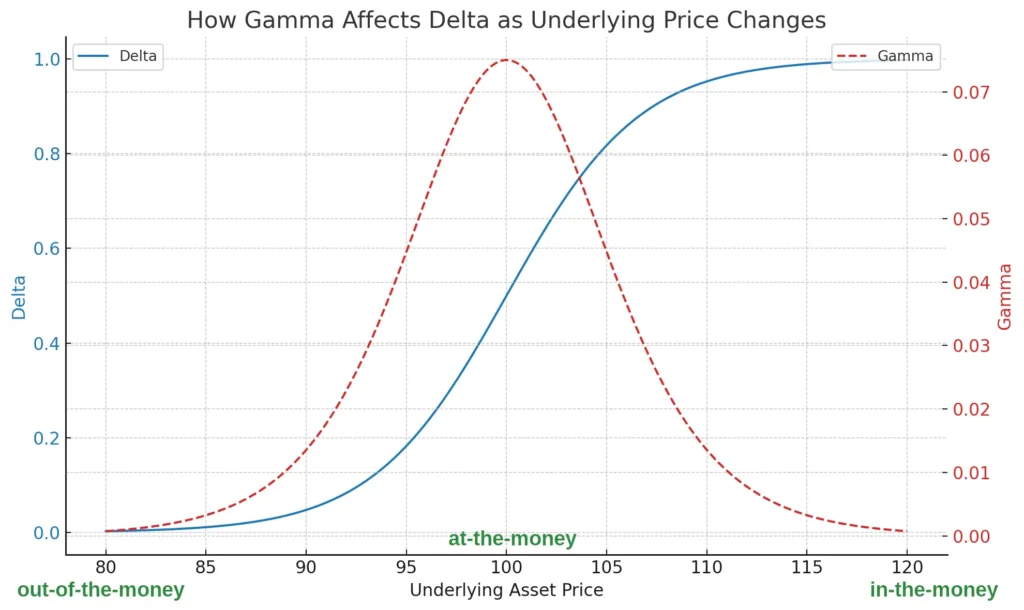
The chart below shows how gamma affects delta as the price of the underlying asset changes. The blue line represents delta, which moves gradually from 0 to 1 as the option goes from out-of-the-money to in-the-money. The red dashed line is gamma, which peaks near the at-the-money price (around 100) and shows how quickly delta changes, this is where options are most sensitive.
How to Calculate Option Gamma
Option gamma calculation involves complex derivatives, but traders often rely on their trading platform to provide gamma values. Still, understanding the factors that influence gamma is essential:
Factors Affecting Gamma
- Time to expiry: Less time = higher gamma
- Strike price: At-the-money = highest gamma
- Volatility: Higher implied volatility can moderate gamma
While the formula for gamma is:
Gamma = ∂²Option Price / ∂(Underlying Price)²
most traders focus on interpretation rather than manual calculation.
Gamma Scalping: A Popular Gamma Trading Strategy
Gamma scalping is a dynamic strategy used to profit from the volatility of the underlying asset, while delta-neutrality is maintained. Here’s how it works:
How Gamma Option Scalping Works
- Start with a delta-neutral position (e.g., long straddle).
- As the underlying price moves, the position becomes delta-positive or negative.
- Buy or sell the underlying to bring delta back to neutral.
- Repeat this process to capture profits from volatility.
This is part of a broader gamma trading strategy, often employed by institutions or traders managing large books of options.
Gamma Short and Gamma Hedge: Gamma Option Risk Considerations
Being gamma short means that your position’s delta will move against you as the underlying price moves, increasing risk as the market becomes more volatile. This is typical for:
- Naked short option positions
- Option writing strategies like iron condors or credit spreads
To mitigate this risk, traders use a gamma hedge, which involves offsetting positions (often with long options) to limit exposure to gamma risk.
Gamma Option Hedge Example
- Short call at $100 strike
- Buy a long call at $105 strike
- Helps flatten the gamma curve while still taking a directional view
Delta and Gamma in Options: Why Both Matter
Understanding delta and gamma in options is crucial for effective risk management:
| Greek | Meaning | Sensitivity |
|---|---|---|
| Delta | Change in option price per $1 move in the underlying | First-order sensitivity |
| Gamma | Change in delta per $1 move in the underlying | Second-order sensitivity |
While delta helps with directional bets, gamma shows how unstable that delta is. Together, they provide a fuller picture of risk exposure.
Tips for Gamma Option Trading
Here are some actionable tips for using gamma in your options trading:
- Monitor gamma near expiry: Gamma increases rapidly as expiry approaches.
- Use gamma scalping in volatile markets: It can help capitalize on short-term movements.
- Be cautious with gamma short positions: These can become high-risk quickly.
- Balance delta and gamma: Look for trade setups that offer a stable risk profile.
Did You Know About Gamma Options?
- Gamma is part of the “Greeks,” which also include delta, theta, vega, and rho.
- Market makers use gamma trading strategies to stay delta-neutral while capturing premium.
- A gamma spike often occurs during major earnings announcements or macroeconomic events.
- High gamma = high “convexity” = large swings in delta = more active management required.
Frequently Asked Questions About Gamma Option
What is gamma in options trading?
Gamma measures how fast delta changes as the price of the underlying asset changes. It’s important for assessing the non-linear risk in an option position.
How is gamma different from delta?
Delta measures the option price’s sensitivity to price movements. Gamma measures how delta changes, i.e., the sensitivity of the sensitivity.
Why is gamma highest at-the-money?
At-the-money options are most sensitive to price changes in the underlying, so their delta shifts rapidly—leading to high gamma.
What does it mean to be gamma short?
Being gamma short means that your delta becomes more unfavorable with price movement, increasing your risk and requiring more frequent adjustments.
Can retail traders use gamma scalping?
Yes, but it requires fast execution, tight spreads, and sufficient capital to manage underlying positions dynamically.
How does gamma affect options near expiry?
As expiry nears, gamma increases dramatically for at-the-money options, making the delta change very rapidly. This leads to higher sensitivity and potential volatility.
Is gamma important in credit spreads?
Yes. For example, in bull put credit spreads, being gamma short means the position can worsen quickly if the underlying moves against you.
Gamma Option Conclusion
Understanding the gamma option is essential for anyone involved in options trading. Whether you’re hedging, speculating, or managing a portfolio, gamma helps you grasp how your position will evolve with market movement.
From gamma scalping strategies to gamma hedging, mastering gamma gives you a significant edge in dynamic market conditions.
Want to learn more about the Greeks in trading? Explore our Options section for in-depth insights.